Technologist

Originals

In leadership conversations, we often celebrate creativity and innovation. Yet, in practice, most organizations reward reliability, predictability, and risk avoidance. This tension creates a fundamental challenge: how do we encourage people to challenge the status quo without destabilizing what already works?

In Originals, Adam Grant explores what separates those who simply generate ideas from those who successfully champion them. I have summarised perspectives from each chapter below.

1. Creative Destruction

Grant highlights a paradox: high achievement motivation can actually suppress originality. When the desire to succeed becomes intense, it is often accompanied by a deep fear of failure. Instead of pursuing bold ideas, individuals gravitate toward safer paths that guarantee success.

Many great creators were held back not by lack of talent, but by reluctance to challenge entrenched norms. Originality is an act of creative destruction.Originals achieve this by questioning defaults and balancing risk portfolio.

2. Blind Inventors and One-Eyed Investors

Experience is valuable, but it can also become a constraint. Success in one domain does not automatically translate to success in another. Entrepreneurs who thrive in a familiar field often struggle when they venture into new territories. Domain inexperience, hubris and enthusiasm can lead to blind spots. Original thinking benefits from fresh perspectives, but execution still requires contextual understanding. Leaders must recognize that innovation demands both new viewpoints and grounded expertise.

3. Out on a Limb

Leadership influence depends not only on authority, but on how people perceive and respect one another. We need to tease apart two major dimensions of social hierarchy that are often lumped together: power and status. Power involves exercising control or authority over others while status is being respected and admired. Original ideas are more likely to gain traction when individuals build status rather than rely on power. Status creates psychological safety for dissent, while power can silence it.

4. Fools Rush In

Contrary to popular belief, successful innovators are not reckless risk-takers. Risk seekers often fail because they act impulsively, chasing novelty without preparation. In contrast, more risk-averse entrepreneurs tend to succeed by carefully timing their entry and balancing risk portfolios. The book explores wwo radically different styles of innovation: conceptual and experimental. Conceptual innovators formulate a big idea and set out to execute it. Experimental innovators solve problems through trial and error, learning and evolving as they go along. Both paths can lead to originality. The difference lies not in courage alone, but in how individuals approach uncertainty.

5. Goldilocks and the Trojan Horse

Original ideas often face resistance when they appear too radical or unfamiliar. Successful change agents find ways to present ideas that are neither too extreme nor too conventional. They frame innovation in ways that feel recognizable and acceptable while still introducing meaningful change. Sometimes, originality succeeds not by confronting systems directly, but by working through them like a Trojan horse that enters quietly before transforming from within.

6. Rebel with a Cause

Original thinkers are often seen as rebels, but their motivations differ from simple nonconformity. Originals do not resist norms for the sake of rebellion. Instead, they are driven by a deep commitment to purpose and improvement. Their actions are anchored in values, not just defiance. Leadership plays a crucial role here. When organizations channel rebellious energy toward constructive goals, dissent becomes a source of progress rather than disruption.

7. Rethinking Groupthink

Strong cultures can either enable originality or suppress it. The presence of dissent distinguishes a strong culture from a cult. Healthy cultures encourage employees to challenge ideas, question decisions and offer alternative viewpoints. Individuals who drive such cultures as shapers – independent thinkers who are curious, nonconforming and rebellious. They practice non-hierarchical honesty, speaking up regardless of position. Organizations that truly value diversity do not merely tolerate dissent, they actively promote it.

8. Rocking the Boat and Keeping It Steady

Originality requires balancing optimism with caution using two mindsets: strategic optimism and defensive pessimism. Strateegic optimists anticipate the best, staying calm and setting high expectations. Defensive pessimists expect the worst, feeling anxious and imagining all things that can go wrong. Psychologically, we have a go system and stop system. Stop system slows us down and makes us cautious and vigilant. Go system revs us up and makes us excited. When we are not yet committed to a particular action, thinking like a defensive pessimist can be hazardous. But once we have settled on a course of action, when anxieties creep in, it is better to think like a defensive pessimist and confront them directly. Successful originals learn to switch between these mindsets depending on the stage of action.

Originals challenges the romanticized view of innovation as a product of bold personalities alone. Instead, it shows that originality emerges from a combination of mindset, strategy, social dynamics and leadership support. The book’s central message is clear: originality is not about constant risk-taking or rebellious behavior. It is about thoughtfully questioning defaults, managing risks intelligently, encouraging dissent and creating environments where new ideas can survive long enough to succeed.

For leaders, the task is not merely to demand innovation but to build conditions where challenging the status quo is both possible and safe.
Loonshots

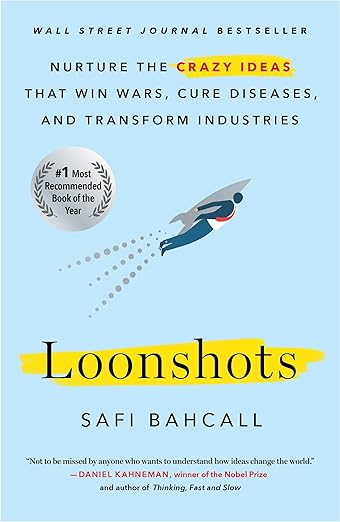
I received a recommendation to read Loonshots by Safi Bahcall in the context of transformation leadership, particularly the idea of intellectual stimulation. This book challenges a widely held assumption about group behavior that radical breakthroughs are primarily driven by culture. Instead, it explains how small shifts in structure and incentives can cause teams to suddenly move from embracing bold ideas to rejecting them and what leaders can do to ensure that breakthrough ideas survive inside large organizations.

A loonshot is a high-risk, high-reward idea that challenges existing beliefs. Because of this, loonshots are widely dismissed ideas and their champions are frequently written off as crazy. Ironically, the most important breakthroughs in history began exactly this way as loonshots.

In Loonshots, Safi Bahcall explores why organizations repeatedly fail to nurture such ideas. He does not blame people, culture, or leadership intent. Instead, he focuses on the structures and incentives that shape behavior. The book’s central insight is simple yet powerful: organizations don’t fail at innovation because they lack vision; they fail because they unknowingly cross invisible thresholds that change how people act.

The book introduces two essential modes of operation:

  • Loonshots: Experimental ideas focused on discovering something new. People who excel here operate with an artist mindset.
  • Franchises: Proven products, processes, or businesses focused on execution. Excellence here requires a soldier mindset.

Both are essential. Loonshots create the future. Franchises sustain the present. The problem arises when organizations treat both modes the same way. Execution-oriented rules of predictability, efficiency, accountability are detrimental to early-stage ideas. At the same time, excessive experimentation can destabilize franchises. Great leaders don’t choose between loonshots and franchises. They promote both.

The book outlines four rules leaders can follow to achieve a healthy balance between loonshots and franschises in large organizations.

1. Separate the Phases

  • Separate artists and soldiers.
  • Tailor tools, incentives and metrics to the phase.
  • Watch for blind spots while nurturing both types of loonshots: P-type (product-driven) and S-type (strategy-driven).

2. Create Dynamic Equilibrium

  • Love artists and soldiers equally.
  • Manage the transfer, not the technology. Be a gardener, not a Moses.
  • Appoint and train project champions who can bridge the divide by being aware of false fails and listening to the suck with curiosity.

3. Spread a System Mindset

  • Keep asking why the organization made the choices it did.
  • Keep asking how decision-making processes can be improved.
  • Identify teams operating with outcome mindsets and help them shift toward a systems mindset.

4. Raise the Magic Number

Formula for the critical size of the organization or the magic number above which the balance shift from favoring project work to politics: M = E × S² × F / G, where E = soft equity, S = span of control, F = project-skill fit, G = growth (compensation / promotion). 

Leaders can raise this threshold by acting on key levers:

  • Reduce the return on politics by making lobbying for promotions and compensation difficult.
  • Use soft equity, non-financial rewards that carry disproportionate impact.
  • Increase project–skill fit by actively scanning the org for mismatches.
  • Fix the middle by paying attention to middle-management layers, where politics often overpower innovation.
  • Fine-tune spans of control: widen spans in loonshot groups to encourage looser controls, experimentation, and peer-to-peer problem-solving.
  • Bring a gun to the knife fight. Use specialists who understand these subtle dynamics.

Loonshots reframes innovation as a systems problem, not a people problem. Breakthrough ideas don’t fail because they are wrong; they fail because organizations unintentionally make them impossible to survive. For a loonshot nursery to flourish, three conditions must be present: Phase separation, Dynamic equilibrium and Critical mass.

The leadership challenge is not to demand more creativity, but to design conditions where fragile ideas can take root without disrupting what already works. When leaders get this balance right, they don’t just innovate, they build organizations capable of doing so again and again.

Containerization: CI/CD Pipelines for 12-Factor Applications

In my last posts, I covered how the 12-Factor methodology shapes modern applications, and how Spring Boot helps translate those principles into production-ready microservices. Once the application foundation is in place, the next step is to automate build, test, and quality checks — ensuring every change is consistent, reliable, and deployment-ready.

This post focuses on CI/CD as the enabler of discipline and quality, while containerization and orchestration will be covered in the next post.

1. Automate the Build

  • Use Maven to manage dependencies and standardize builds.
  • Leverage Jenkins to automate compilation, packaging, and artifact generation.
  • Ensure the build process is repeatable and deterministic, so the same code produces the same artifact across environments.
  • Package applications into JAR / WAR files as the unit of deployment.

Automated builds with Jenkins create a foundation where every commit can be compiled, packaged, and verified without manual steps.

2. Embed Quality Gates

Quality gates enforce standards and catch issues early:

  • SonarQube: code smells, duplication, and standards enforcement.
  • CAST: architecture compliance and technical debt tracking.
  • Checkmarx: security vulnerability scanning to shift security left.
  • Unit & Integration Tests: automated tests with coverage thresholds prevent regressions.

Integrating these tools into Jenkins pipelines ensures the CI/CD process is not just a delivery mechanism but a quality enforcer.

3. Align Environments

CI/CD ensures consistent execution across dev, staging, and production:

  • Automates environment setup and configuration.
  • Injects secrets securely, avoiding hardcoding.
  • Externalizes environment-specific values, aligning with 12-Factor principles like config separation and parity across environments.

4. Extend Beyond Functional Requirements

CI/CD is also the right place to embed non-functional requirements (NFRs):

  • Logging streamed to Splunk for centralized analysis.
  • Monitoring with Datadog for observability and alerting.
  • Messaging pipelines integrated with Kafka for scalability and decoupling.

Automation here ensures applications are production-ready, not just feature-complete.

5. Prepare for Containerization

Once builds pass all gates, the artifacts are fully production-ready. These artifacts — whether JARs or WARs — serve as the foundation for the next stage: packaging into Docker containers. Containers make applications portable, immutable, and easily deployable, bridging CI/CD with orchestration in Kubernetes, the focus of the next post.

Automation is not just about speed; it’s about consistency, discipline, and trust. A robust CI/CD pipeline, implemented in Jenkins, enforces 12-Factor practices, embeds NFRs, and accelerates feedback loops while reducing human error.

With build, test, and quality gates in place, teams are ready to containerize applications with Docker and orchestrate them with Kubernetes, moving one step closer to cloud-native microservices.

Containerization: Building 12-Factor Microservices with Spring Boot

In my last post, I explored how the 12-Factor App principles serve as a blueprint for building cloud-ready applications. In this post, I shift focus to a practical enabler of those principles: Spring Boot.

Spring Boot has become the go-to framework for building microservices-based applications that are cloud-native and production-ready. Why? Because it brings together the power of the Spring ecosystem with a level of developer productivity that directly aligns with 12-Factor principles.

Spring Boot is built on top of the Spring framework, which itself provides several foundational advantages:

  • Dependency Injection: Spring’s core feature, simplifying the management of components and making applications loosely coupled and testable.
  • Spring MVC: A module that streamlines the creation of web applications and REST APIs, which are fundamental in microservices architectures.

Spring Boot takes these strengths further by accelerating application development and production readiness:

  • Rapid development: Through Spring Initializr, starter projects, auto-configuration, and developer tools, teams can bootstrap applications quickly.
  • Production-ready by design: Spring Boot accelerates key non-functional requirements (NFRs):
    • Logging and error handling baked in.
    • Profiles and configuration properties to separate environments cleanly.
    • Actuator for health checks and monitoring.
    • Embedded servers for simplified deployment.

This combination allows teams not only to build apps quickly but also to meet the robustness, scalability, and observability expectations of modern cloud environments.

Building a 12-Factor App with Spring Boot
Spring Boot provides out-of-the-box support to implement each of the 12-Factor principles in practice. A few highlights:

  • Codebase: Use Git for a single codebase per service, keeping our Spring Boot app modular and clean.
  • Dependencies: Declared explicitly in pom.xml using Spring Boot starters.
  • Config: Externalized with application.properties or application.yml, augmented with profiles for environment-specific values.
  • Backing services: Treat databases, message brokers, and caches as attached resources. For example, integrate Kafka for event streaming and inject it via configuration rather than hardcoding.
  • Processes: Applications run as stateless processes, packaged into lightweight containers with Docker, and deployed onto Kubernetes for orchestration, scaling, and resilience.
  • Logs: Streamed to standard output and shipped to tools like Splunk for centralized analysis and alerting.
  • Admin/management: Exposed via Spring Boot Actuator endpoints, and extended with observability platforms like Datadog to monitor performance, reliability, and resilience.

By mapping Spring Boot’s features directly to the 12-Factor methodology, we move beyond theory into tangible implementation.

Spring Boot doesn’t just speed up development—it embeds cloud-native best practices into the foundation of our applications. When combined with CI/CD, Docker, Kubernetes, Kafka, Splunk, and Datadog, it becomes a powerful accelerator for building scalable, portable, and resilient microservices.

Containerization: Practical Steps for CI/CD, Containers and Kubernetes

In my last post, I revisited the 12-Factor App Principles – a blueprint for building applications that are portable, resilient, and scalable. This post takes the next step: how do we actually build containerized apps that bring those principles to life? I have been exploring this journey for a while: starting with a Spring Boot application, applying 12-Factor discipline, and then setting up pipelines, containers, and orchestration. Here are the four high-level steps for moving from principles to practice.

1. Build the application with 12-factor principles

An app needs to be designed for the cloud from day one:

  • A clean codebase tracked in version control.
  • Explicitly declared dependencies (no hidden assumptions).
  • Config externalized into the environment—not baked into code.
  • Stateless processes that can scale horizontally.
  • Logs treated as event streams, not files.

This ensures the foundation is right before we even think about containers.

2. Automate build & quality gates via CI/CD

A reliable build pipeline is the backbone of cloud-ready apps. This is where we codify consistency and quality:

  • Use Maven or Gradle to manage dependencies and standardize builds.
  • Leverage Jenkins to automate compilation, packaging, and artifact generation.
  • Code quality checks via SonarQube (for code smells, duplication), CAST (for architecture, technical debt, and maintainability), and Checkmarx (for security vulnerabilities).
  • Test coverage integrated into the pipeline to catch regressions early.
  • Environment setup so dev, staging, and prod remain aligned.

This is also the right stage to embed non-functional requirements – such as security, performance, and maintainability – into the software delivery lifecycle.

3. Containerize the Application

Once the pipeline is humming, the next step is to containerize:

  • Write a Dockerfile that packages our app into a lean, immutable image.
  • Follow best practices: use minimal base images, avoid hardcoding secrets, and leverage multi-stage builds.
  • Validate disposability: fast startup, graceful shutdown, and statelessness.

The container becomes the unit of deployment, fully aligned with the principles we started with.

4. Orchestrate & Deploy

Finally, deploy the containerized app in an orchestrated environment:

  • Deploy to Kubernetes for enterprise-grade orchestration – scaling, self-healing, and rolling updates.
  • Manage configuration using ConfigMaps (non-sensitive configs like DB hostnames, log levels) and Secrets (sensitive values like passwords, tokens, certificates). This approach ensures container images remain immutable, while environment-specific values are injected securely at runtime.
  • Validate resilience: scale pods up and down, perform rolling upgrades, and monitor logs as event streams.

This step is where our app truly becomes cloud-native: portable across environments, scalable under load, and manageable at enterprise scale.

The 12-Factor methodology comes to life when combined with automation, containerization, and orchestration. By following these four steps, teams move from abstract principles to concrete, cloud-ready deployments.

Containerization: 12-Factor App Principles

One of my blog readers reminded me recently that it has been a while since he saw a tech piece from me. In parallel, I have been immersed in containerization work and it gave me the nudge to reflect on how we design and build modern, cloud-ready applications. This post marks the beginning of a blog series where I will walk through the journey of building a versatile application: from principles to deployment.

We will start with the foundations – The 12-Factor App Principles. From there, we will move into a hands-on Spring Boot app (Java is still home turf for me), then look at containerizing it with Docker, and finally deploying on Kubernetes. I believe that writing software today is no longer just about what the app does, but how it runs anywhere—with consistency, reliability, and scalability.

Why 12-Factor Still Matters

Introduced in 2011 by Heroku, the 12-Factor methodology offers a pragmatic blueprint for building SaaS applications that are portable and resilient. For those of us who grew up in the world of monoliths and app servers, this feels like the architectural decluttering we always needed but did not know how to articulate.

Let’s briefly explore each of the 12 principles as a set of operating philosophies that guide how we write, organize, and deploy our code in a modern landscape.

  1. Codebase – One codebase per app that serves many deploys from configurations.
  2. Dependencies – Explicitly declare and isolate dependencies.
  3. Config – Store config in the environment and not the code.
  4. Backing Services – Treat backing services as attached resources.
  5. Build, Release, Run – Strictly differentiate build, release and run stages.
  6. Processes – Execute app as one or more stateless processes.
  7. Port Binding – Expose services through port binding.
  8. Concurrency – Scale out by running more instances. This principle will come alive when we get to Kubernetes.
  9. Disposability – Fast startup and graceful shutdown to maximise robustness.
  10. Dev / Prod Parity – Keep development, staging and production as similar as possible.
  11. Logs – Treat logs as event streams.
  12. Admin Processes – Run admin / management processes as one-off tasks independently.

The 12-Factor methodology lays the foundation for building applications that are portable, resilient, and scalable. In the next post, we will bring these principles to life with a Spring Boot project designed with the cloud in mind.

Aspiration, Inspiration & Relentless Perseverance

I was invited to be the Guest of Honour at the Graduation Day for the Class of 2022 of HITAM (Hyderabad Institute of Technology and Management). This was my first time playing this role and should thank Ms Sheenam Ohrie, Broadridge India MD for providing this opportunity. A special thanks to Mr Vamsi Koka, Dean – Strategy & Operations and the leadership at HITAM for making it a memorable experience. It was a great honour to be at the stage with Padmashri Prof Sanjay Dhande, Former Director of IIT Kanpur and the Chairman of the Governing Body of HITAM who graced the occasion as the Chief Guest.

I have heard some legendary speeches from great leaders addressing students during their commencement or graduation ceremonies and wanted to make some sense during my five-minute message to the students. It was about six months since these students completed their engineering curriculum and all of them should have started their career as a professional or an entrepreneur or should be pursuing higher studies. So, I shared three essential qualities that have served me well throughout my professional career over the years. I strongly believe they will help anyone who want to succeed in their life:

  • Aspiration: A strong hope and ambition of achieving something has differentiated humans from other animals. It is the aspiration of humanity that led to agricultural, scientific, industrial and information technology revolutions over the last ten thousand years. As Sir Isaac Newton said “If I have seen further than others, it is by standing upon the shoulders of giants”. Each one of us have the opportunity to be such a giant for our posterity if we are aspirational with a meaningful purpose and vision.
  • Inspiration is the urge to do something and can trigger an aspiration or at times can also help achieve an ambition. As we grow up, we are inspired by several people and some of them also become role models. Personally for me, my parents have been an inspiration, a number of sports people and exceptional achievers in several fields have inspired me. We get inspired by nature as well, remember the legendary story of Robert Bruce being inspired by a spider and just imagine the sheer beauty of the world around us. We all are inspired by different things, but is it most important to follow that urge and strive to become an inspiration for others through our success.
  • Relentless perseverance: Once we are inspired and commit to be aspirational, the next step is relentless perseverance towards our goal. Many of us dream of luxury and expect it to make us happy. But try to remember the moments that you cherish the most in life and the ones that you are most proud of. Are they the time you spent in luxurious comfort or your achievements overcoming massive difficulties through hard work with sustained intensity and enduring pain towards a meaningful purpose? It is usually the latter.

I strongly encourage you to aspire, inspire and perspire towards your goals. We all have limited time in this world and every day, hour and minute is precious. Before you decide on how to spend this precious time, think how you will feel about your choice ten years from now. We are fortunate to be living at a time when knowledge is democratized and each one of us have numerous opportunities to make a difference. Please make it count to take yourself and your community forward.

I jotted this down as a blogpost so that I can see for myself ten years from now on how I feel about this!

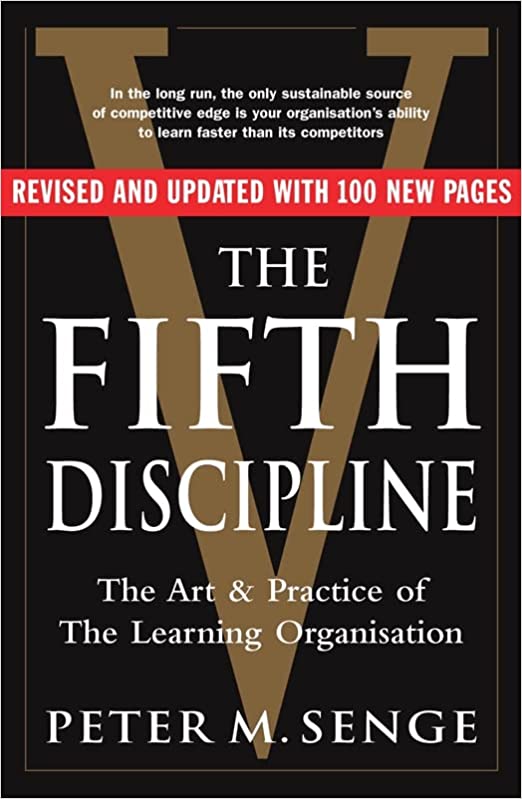
The Fifth Discipline

One of the few books that keeps coming to my mind and reminds me of my north star every time I need help is “The Fifth Discipline – The Art & Practice of The Learning Organization” by Peter Senge. I have used the principles and learnings from this book countless number of times during the last ten years since I read this book. 2022 has been an extremely busy year for me at work and have neither been able to read many books nor post any blogs. So, thought I will celebrate tenth anniversary of reading this book by sharing the key learnings from this book here.

Peter Senge aptly uses the example of aviation technology taking more than thirty years to serve general public after Wright brothers invented flying to highlight that an idea moves from invention to innovation only when diverse “component technologies” comes together to integrate an ensemble of technologies that are critical to one another’s success. Similarly, there are five “component disciplines” are gradually converging to innovate learning organizations. They are – Personal Mastery, Mental Models, Building Shared Vision, Team Learning and Systems Thinking. While the first four are effective on their own to a certain extent, the fifth discipline of Systems Thinking integrates the other disciplines, fusing them into a coherent body of theory and practice.

This blog post is not about these disciplines or even Systems Thinking but lists out two key topics that provides an understanding and basis for the core disciplines for building a learning organization. These topics are the 7 Learning Disabilities that lead to individuals and organizations failing in the long term and the 11 Laws of the Fifth Discipline that enables an organization to sustain its ability to learn and grow.

Learning Disabilities: We have seen a number of well-established companies vanish over a short period of time. A study estimates that the average lifetime of the largest industrial enterprises is less than forty years, roughly half the lifetime of a human being! We have seen a number of industry leaders disappear during the last fifteen years, the ones relevant to our context will be Blackberry, Nokia, Kodak and Blockbuster to name a few. In all these companies, there was abundant evidence in advance that the firm was in trouble. The evidence goes unheeded, though the individual managers are aware of it. The organization as a whole cannot recognize impending threats, understand the implications of those threats or come up with alternatives. This is a reflection of these organizations failing to learn, which could be due to a number of reasons – they way they are designed and managed or the way people’s jobs are defined. Most importantly, the way we have all been taught to think and interact create fundamental learning disabilities. It is important that we learn to recognize when these disabilities occur and take corrective action.

  1. I am my position: We are trained to be loyal to our jobs – so much so that we confuse them with our own identities. When people in organizations focus only on their position, they have little sense of responsibility for the results produced when all positions across the organization interact. Moreover, when results are disappointing, it can be very difficult to know why and the default assumption is that “someone else screwed up”.
  2. The enemy is out there: Humans have the propensity to find someone or something outside ourselves to blame when things go wrong. In a Product Development organization, it is common for business analysts and testers to blame developers – “if only developers write quality code, we can satisfy customers”. Developers and business analysts blame testers – “if only QA tests important scenarios, we can prevent defects in production”. Testers and developers blame business analysts – “if only BAs provide proper requirements, we can deliver solutions that customers really need”. “The enemy is out there” syndrome is actually a by-product of “I am my position” , and the non-systemic ways of looking at the world that it fosters.
  3. The illusion of taking charge: Many a times, managers proclaim the need for taking charge in facing difficult problems, be proactive in approach rather than react. But if we simply become more aggressive fighting “the enemy out there”, we are only reacting. True proactiveness comes from seeing how we contribute to our own problems.
  4. The fixation on events: Conversations in many organizations are dominated by concern with short-term events like new budget cuts, who just got promoted or fired, missed milestone, etc. Our fixation of events is actually part of our evolutionary programming where our ancestors primarily needed only the ability to react to immediate threats to survive another day. However, if we focus on just events, the best we can ever do is predict an event before it happens so that we can react optimally. But we can never learn to create.
  5. The parable of the boiled frog: If you place a frog in a pot of boiling water, it will immediately try to scramble out. But if it is water at room temperature that is heated slowly, it will become groggier until it is unable to climb out of the pot. Similarly, we are also tuned to sensing sudden changes in our environment, but not to slow, gradual changes. We slip into what is famously referred as comfort zone and becomes very difficult to get out of it.
  6. The delusion of learning from experience: We learn from our experience but never directly experience the consequences of many of our important decisions. The most critical decisions made in organizations have systemwide consequences that stretch over years or decades.
  7. The myth of the management team: Every organization has a management team that is a collection of savvy, experienced managers who represent the organization’s different functions and areas of expertise. All too often, the managers tend to spend time fighting for turf, avoiding anything that will make them look bad personally and pretending that everyone is behind the team’s collective strategy.

This book covers these learning disabilities to highlight the need for the five disciplines of the learning organization. After I read this book ten years back, I consciously take a step back once in a while to introspect and look for any of these disabilities in myself and try to overcome if I found any.

The Laws of the Fifth Discipline: Systems Thinking that enables understanding complexity is the cornerstone of the learning organization. The eleven laws of this discipline helps us look at problems and opportunities holistically and avoid pitfalls of siloed thinking.

  1. Today’s problems come from yesterday’s “solutions”: Often we are puzzled by the causes of our problems, when we merely need to look at our own solutions to other problems in the past. For example – an organization that prioritizes reducing time to market thereby rushing a product to the market ends up dealing with quality issues and frustrated customers. Solutions that merely shift problems from one part of a system to another often go undetected because those who solved the first problem are different from those who inherit the new problem.
  2. The harder you push, the harder the system pushes back: Well-intentioned interventions to solve a problem call forth responses from the system that offset the benefits of the intervention, this phenomenon is called “compensating feedback”. For example – a person quits smoking to become more healthy but ends up gaining weight and suffers such a loss in self-image that he takes up smoking again to relieve the stress. When our initial efforts fail to produce lasting improvements, we push harder without understanding compensating feedback.
  3. Behavior grows better before it grows worse: Low-leverage interventions to solve problems actually work in the short-term as compensating feedback usually involves a delay. We declare victory too early and a new problem eventually shows up elsewhere in the system that someone else needs to solve now.
  4. The easy way out usually leads back in: We find comfort applying familiar solutions to problems, sticking to what we know best as it is easy for us. Pushing harder on familiar solutions while fundamental problems persist or worsen is a reliable indicator of non-systemic thinking reflecting “what we need here is a bigger hammer” syndrome
  5. The cure can be worse than the disease: Sometimes familiar solutions are not only effective but also addictive and dangerous. Alcoholism may start as simple social drinking to relieve stress but causes addiction and bigger problem in the long-term.
  6. Faster is slower: Organizations often go for quick fixes for problems that deliver results fast but don’t last long, despite being aware that solutions that stick take longer to show results.
  7. Cause and effect are not closely related in time and space: We tend to address symptoms rather than root cause as symptoms are readily visible while the real causes might have occurred at a different time. The first step in correcting this mismatch is to let go of the notion that cause and effect are closely related in time and space.
  8. Small changes can produce big results – but the areas of highest leverage are often the least obvious: We are usually tempted to go for familiar solutions to problems as they are the most obvious and easy to understand and implement. Understanding the system as a whole and deep analysis to identify the real underlying issue will help identify those small changes that have the potential to deliver the most.
  9. You can have your cake and eat it too – but not at once: Sometimes the knottiest dilemmas, when seem from systems point of view, are not dilemmas at all. They may just be false dichotomies. For example, we might not have to make a choice between quality and cost. They may both go up in the short-term but reduced rework in the long-term can bring in the required cost savings.
  10. Dividing an elephant in half does not produce two small elephants: Organizations are living systems that have integrity. Their character depends on the whole. Understanding the most challenging managerial issues require seeing the whole system that generates these issues. Dividing the system into silos can break this integrity.
  11. There is no blame: We tend to blame “others” for our problems. Systems thinking shows that there is no separate “other”, that you and the “other” are part of a single system.

Understanding the learning disabilities and the laws of systems thinking has helped me getting to the root of many problems over the years. It also prevented me from falling into the trap of familiar solutions that provide short-term relief but lead to bigger problems in the long-term.

Think Again

I began 2022 with Adam Grant‘s latest book “Think Again: The Power of Knowing What You Don’t Know“. This book is an invitation to let go of knowledge and opinions that are no longer serving us well, and to anchor our sense of self in flexibility rather than consistency. This also means abandoning some of our most treasured tools and some of the most cherished parts of our identity.

The key is “rethinking” – adopting mental flexibility to let go of our long held assumptions and have the courage to challenge our self-beliefs that might have led to success in the past but no longer relevant for the future. As an example, the COVID-19 pandemic has forced organizations to rethink the value of co-located teams working in close physical proximity all the time to deliver projects. Instead, all organizations are now exploring the flexibility offered by remote work for people to balance their professional and personal goals better. Contrary to long held belief, many remote teams have been more productive working from home as they repurposed unproductive time spent on activities like the office commute. It does not mean that remote work will be the better option forever, we are certain to encounter new challenges and we need to rethink again to address them.

This book makes a case for rethinking at three levels – Individual, Interpersonal and Collective.

Individual Rethinking – Updating our own views:

  1. A Preacher, a Prosecutor, a Politician and a Scientist walk into your mind: Our assumptions and beliefs often drive us towards two biases – Confirmation bias (seeing what we expect to see) and Desirability bias (seeing what we want to see). These biases contort our intelligence into a weapon against the truth. We find reasons to preach our beliefs more deeply, prosecute our case more passionately and ride the tidal wave of our political party. The tragedy is that we are usually unaware of the resulting flaws in our thinking. To avoid this conundrum, we should think like a scientist, and NOT like a preacher or a prosecutor or a politician. Thinking like a scientist requires searching for reasons why we might be wrong and revising our views based on what we learn.
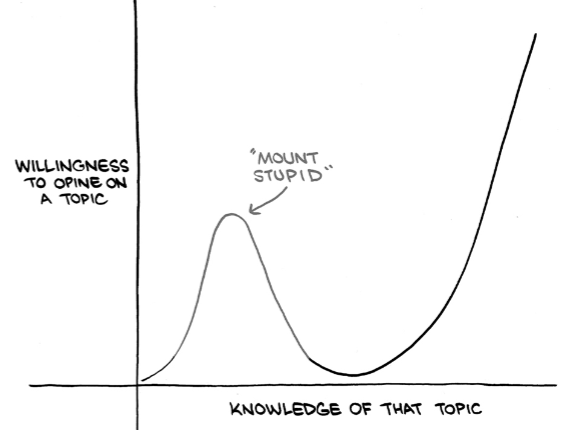
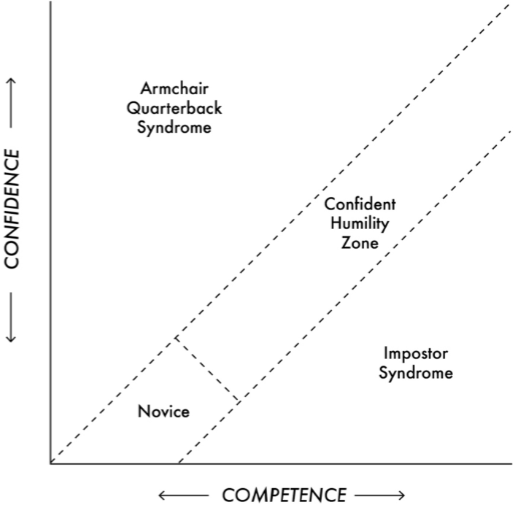
  2. The Armchair Quarterback and the Imposter – Finding the sweetspot of confidence: Knowledge on a topic leads to both competence and confidence, the balance between both of them will determine our personality. We need to be careful when we progress from being a novice to an amateur in a skill as this is the stage when we tend to become overconfident reaching the summit of what is called “Mount Stupid“. As we progress further towards becoming a professional, we realize there is a lot more to learn and usually become more humble. We should strive to reach a state of “Confident Humility” – having faith in our capability while appreciating that we may not have the right solution or even be addressing the right problem. This gives us enough doubt to reexamine our old knowledge and enough confidence to pursue new insights.
  3. The Joy of being Wrong: Most of us are accustomed to defining ourselves in terms of our beliefs, ideas and ideologies. This can become a problem when it prevents us from changing our minds as the world changes and knowledge evolves. Our opinions become so sacred that we grow hostile to the mere thought of being wrong, and the totalitarian ego leaps in to silence counterarguments, squash contrary evidence and close the door on learning. Instead, it is better we define ourselves by our values. Values are our core principles in life – like respect, fairness, empathy, trust, courage, etc. Basing our identity on these kinds of principles enables us to remain open-minded and enjoy instances when were go wrong as opportunities to learn.
  4. The Good Fight Club – The psychology of constructive conflict: High performing groups thrive on task conflict to bring the collective best by challenging different views with mutual respect (so that it does not slip into relationship conflict).

Interpersonal Rethinking – Opening other people’s minds:

  1. Dance with Foes – How to win debates and influence people: When we want to convince others to rethink their opinions, we frequently take an adversarial approach that effectively shuts them down or rile them up instead of opening their minds. They play defense by putting up a shield, play offense by preaching their perspectives and prosecuting ours, or play politics by telling us what we want to hear without changing what they actually think. The better approach will be a more collaborative one, where we show more humility and curiosity, and invite other to think more like scientists. A good debate is not a war, it is more like a dance that has not been choreographed, negotiated with a partner who has a different set of steps in mind. To accomplish this, expert negotiators use a few techniques: acknowledging common ground, presenting fewer reasons to support their case and expressing curiosity with intriguing questions.
  2. Bad Blood on the Diamond – Diminishing prejudice by destabilizing stereotypes: In every human society, people are motivated to seek belonging and status. Identifying with a group checks both boxes at the same time: we become part of a tribe and we take pride when our tribe wins. This leads to rivalries between tribes (teams) that are typically geographically close, compete regularly and are evenly matched. Some examples in sports is rivalry between India and Pakistan on cricket or between the Yankees and Red Sox in baseball. To reinforce the rivalry, stereotypes are formed and for both mental and social reasons it is hard to undo them. Some of the ways to overcome stereotypes are: come up with shared identify using commonalities (overview effect), humanizing the team and focusing on an individual to explain irrationality of the stereotype.
  3. Vaccine Whisperers and Mild Mannered Interrogators – How the right kind of listening motivates people to change: People with unhealthy additions or unscientific beliefs are usually aware of their fallacies. If we try to persuade them to make a change, we evoke resistance and they are less likely to change. We can rarely motivate someone else to change, instead we are better off helping them find their own motivation to change. “Motivational Interviewing” is a practice that can help with this. Motivational interviewing starts with an attitude of humility and curiosity. Our role is to hold up a mirror so they can see themselves more clearly, empower them to examine their beliefs and behaviors that can activate a rethinking cycle. Three key techniques for motivational interviewing are: asking open-ended questions, engaging in reflective listening and affirming the person’s desire and ability to change.

Collective Rethinking – Creating communities of lifelong learners:

  1. Charged Conversations – Depolarizing our divided discussions: As humans, we have the tendency to seek clarity and closure by simplifying complex continuum into two categories. This is called binary bias. While democratization of information through internet was expected to expose us to different views and help us make informed rational decisions, binary bias has instead led to a more polarized world. To overcome binary bias, a good starting point is to become aware of the range of perspectives across a given spectrum and articulate the complexity instead of simplifying it. Some techniques to convey complexity are: including caveats, highlighting contingencies and expressing mixed emotions.
  2. Rewriting the Textbook – Teaching students to question knowledge: With so much emphasis placed on imparting knowledge and building confidence, many teachers don’t do enough to encourage students to questions themselves and one another. It is important to instill intellectual humility, disseminate doubt and cultivate curiosity to develop students of today into confidently humble experts in their respective domains tomorrow.
  3. That’s Not the Way We Have Always Done it – Building cultures of learning at work: Rethinking is more likely to happen in a learning culture, where people strive to know what they don’t know, doubt their existing practices and stay curious. To achieve this “Psychological Safety” – fostering a climate of respect, trust and openness in which people can raise concerns and suggestions without fear of reprise – is essential. In performance cultures, the emphasis on results often undermines psychological safety. When we see people get punished for failures and mistakes, we become worried about proving our competence and protecting our careers. While many organizations strive to build high performance cultures with the right intention, care should be taken to ensure psychological safety in parallel to promote learning culture. Psychological safety should be combined with process accountability to create a learning zone where people feel free to experiment and to poke holes in one another’s experiments in service of making them better.

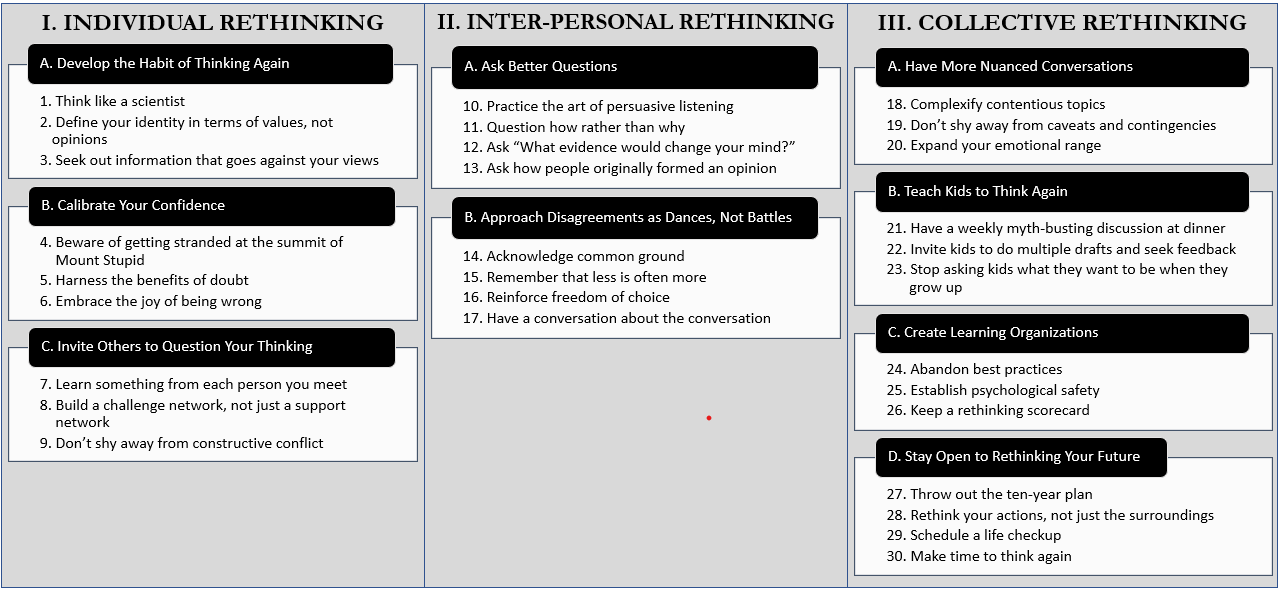
Adam Grant concludes by making a case for regularly reconsidering our best-laid career and life plans to escape tunnel vision that hampers our growth. He leaves us with specific actions for impact, which are his top thirty practical takeaways for working on our rethinking skills. I will conclude this blogpost with these takeaways.