Most organizations compete within existing industry boundaries. They benchmark competitors, optimize costs, improve features and fight for market share. Over time, competition intensifies, differentiation reduces and growth becomes harder to sustain.
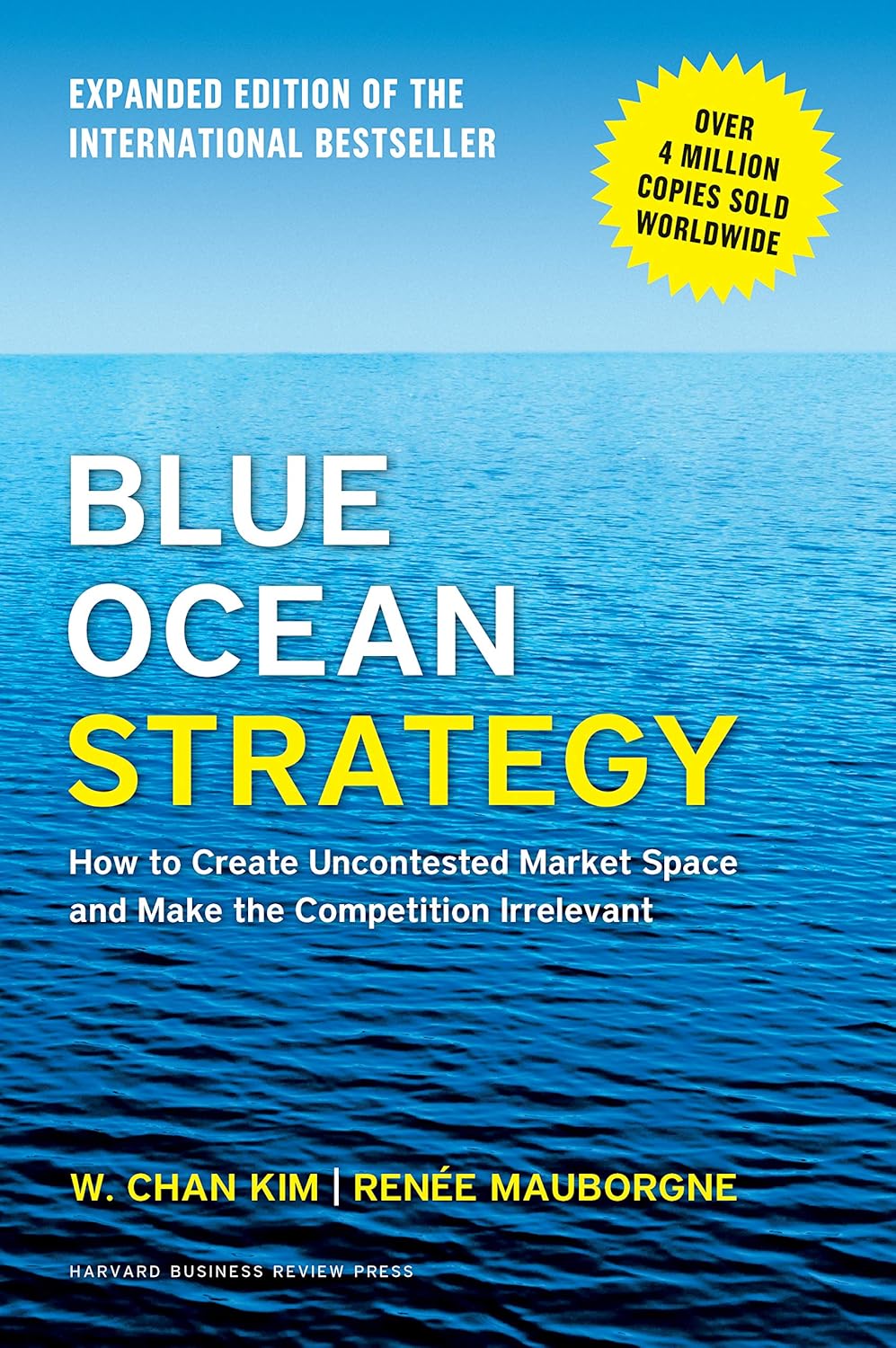
In Blue Ocean Strategy, W. Chan Kim and Renée Mauborgne challenge this conventional approach to strategy. Instead of competing in crowded markets, they argue that organizations should focus on creating blue oceans: new and uncontested market spaces where competition becomes irrelevant.
The book refers to existing crowded markets as red oceans, where industry boundaries are accepted and competitors fight over the same demand. Blue oceans, in contrast, are created by unlocking new demand through value innovation.
Although some blue oceans are created well beyond existing industry boundaries, most blue oceans are created from within red oceans by expanding existing industry boundaries.
Another important insight is that the strategic move, and not the company or the industry, is the right unit of analysis for explaining the creation of blue oceans and sustained high performance.
At the center of blue ocean strategy lies the idea of value innovation. Value innovation occurs only when companies align innovation with utility, price, and cost positions. If organizations fail to anchor innovation with value in this way, technology innovators and market pioneers often lay eggs for other companies to hatch.
Analytical Tools and Frameworks
The Strategy Canvas
The strategy canvas is both a diagnostic and an action framework for building a compelling blue ocean strategy. It helps organizations:
- Understand the factors on which the industry competes
- Identify where competitors are investing
- Visualize the current state of competition
- Discover opportunities for differentiation
A strong blue ocean strategy produces a value curve that stands apart from competitors instead of converging with them.
The Four Actions Framework
To reconstruct buyer value and break the trade-off between differentiation and low cost, the book proposes four questions:
- Eliminate: Which factors that the industry takes for granted should be eliminated?
- Reduce: Which factors should be reduced well below the industry’s standard?
- Raise: Which factors should be raised well above the industry’s standard?
- Create: Which factors should be created that the industry has never offered?
The framework encourages organizations to challenge long-standing assumptions about how value is delivered.
Formulating Blue Ocean Strategy
1. Reconstruct Market Boundaries
The book outlines six paths for reconstructing market boundaries:
- Look across alternative industries
- Look across strategic groups within industries
- Look across the chain of buyers
- Look across complementary product and service offerings
- Look across functional or emotional appeal to buyers
- Look across time
Blue ocean creators challenge assumptions that competitors take for granted.
2. Focus on the Big Picture, Not the Numbers
Blue ocean strategy emphasizes visualizing strategy instead of getting trapped in spreadsheets and operational details. The book outlines a four-step process for visualizing strategy:
- Visual Awakening: Compare the current strategy with competitors and recognize the need for change.
- Visual Exploration: Go into the field to understand customer experience, alternatives, and pain points.
- Visual Strategy Fair: Present strategic options visually and gather feedback from customers, non-customers, and stakeholders.
- Visual Communication: Communicate the final strategy clearly across the organization using before-and-after strategy canvases.
The focus shifts from incremental improvements to strategic transformation.
3. Reach Beyond Existing Demand
Most organizations focus only on existing customers. Blue ocean strategy encourages organizations to unlock new demand by understanding noncustomers. The book identifies three tiers:
- Soon-to-be noncustomers
- Refusing noncustomers
- Unexplored noncustomers
Instead of competing for existing demand, blue ocean creators expand the market itself.
4. Get the Strategic Sequence Right
A blue ocean idea succeeds only when the strategic sequence is correct:
- Buyer utility
- Price
- Cost
- Adoption
Strong ideas fail when organizations cannot align customer utility, strategic pricing, cost structure, and adoption considerations.
Executing Blue Ocean Strategy
5. Overcome Key Organizational Hurdles
Execution often fails because organizations resist change. The book introduces tipping point leadership, which focuses on overcoming:
- Cognitive hurdles
- Resource hurdles
- Motivational hurdles
- Political hurdles
Leaders should focus effort on points of disproportionate influence rather than broad transformation programs.
6. Build Execution into Strategy
Execution should not be separated from strategy. The book emphasizes fair process, built on the three E principles:
- Engagement – Involve people in strategic decisions by asking for their input and allowing them to challenge assumptions.
- Explanation – Clearly explain why final decisions are made, especially when suggestions are not adopted.
- Expectation Clarity – Ensure everyone understands the new rules, responsibilities, and performance expectations.
When people feel heard, respected, and treated fairly, commitment to execution improves significantly.
7. Align Value, Profit, and People Propositions
Sustainable blue oceans require alignment across:
- Value proposition
- Profit proposition
- People proposition
Weakness in any one area weakens long-term success.
8. Renew Blue Oceans
Blue oceans eventually attract imitation and begin turning red. The book highlights several imitation barriers that can delay or discourage competitors:
- Value innovation may not make sense based on conventional industry logic.
- Blue ocean strategies often conflict with competitors’ existing brand images.
- Natural monopolies may emerge due to high market scale.
- Network externalities can make imitation difficult.
- Organizational politics and cognitive barriers can slow competitive response.
Organizations must therefore:
- Continuously monitor strategy canvases
- Keep questioning assumptions
- Balance exploitation with exploration
- Renew blue oceans before commoditization sets in
Blue ocean strategy is not a one-time initiative. It is a continuous strategic discipline.
Blue Ocean Strategy reframes competition itself. Instead of competing harder within existing market boundaries, organizations can create new demand through value innovation and strategic reconstruction of markets.
The book’s most powerful insight is that breakthrough growth does not come merely from technology, differentiation, or operational excellence alone. It emerges when organizations align innovation with buyer utility, price, and cost while systematically challenging industry assumptions.
For leaders, the challenge is not simply to outperform competitors in red oceans, but to create blue oceans where competition becomes far less relevant.