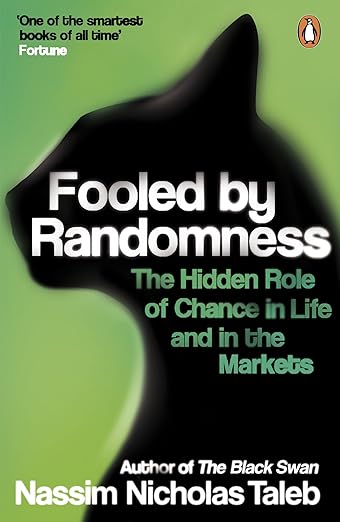
In leadership, business and life, we often attribute success to skill and failure to circumstances. We tend to believe that people who succeed must have made the right decisions, while those who fail must have made mistakes. In Fooled by Randomness, Nassim Nicholas Taleb challenges this assumption and examines how randomness influences our lives and how our minds struggle to recognise its role.
Skill versus Luck
Taleb illustrates the difference between skill and luck by comparing $10 million earned from Russian roulette with a dentist who earns the same amount through the diligent and artful practice of dentistry. Both have accumulated the same wealth and can purchase the same goods. However, the dependence of their outcomes on randomness is fundamentally different.
The outcome alone does not tell us the quality of the process that produced it. We often judge decisions by their results rather than by the quality of the reasoning and risks involved. This can lead us to celebrate reckless decisions that turn out well and criticise sound decisions that produce unfavourable outcomes.
Randomness, History and Induction
Taleb anchors his discussion in Solon’s warning about the unpredictability of fortune and the dangers of drawing conclusions from success. Skewness and asymmetry mean that outcomes are not always distributed evenly, and a small number of events can have a disproportionately large impact.
History presents a particular challenge. We observe events after they have occurred and construct explanations that make them appear logical and predictable. Yet the fact that an event has happened does not mean that it was inevitable or that we could have predicted it.
This is closely related to the problem of induction. No number of observations of white swans can establish that all swans are white, but the observation of a single black swan is sufficient to refute that conclusion.
Induction allows us to move from particular observations to general principles. It is useful because a general rule takes much less room in our memory than a collection of individual experiences. However, this compression can conceal the randomness and variation present in the original observations. The patterns we identify may be less reliable than we believe.
Survivorship Bias: The Winners We See
We tend to focus on those who have succeeded while overlooking those who followed similar paths but failed. Taleb explores this through the examples of monkeys on typewriters and the many millionaires we see around us.
If enough monkeys type randomly for long enough, some will produce meaningful text by chance. Observing the successful result without considering all the unsuccessful attempts can lead us to attribute intelligence or intent where none exists.
Similarly, we hear stories of successful investors, entrepreneurs and business leaders, but rarely examine the many others who took comparable risks and did not succeed. This is survivorship bias: we draw conclusions from the survivors without accounting for those who disappeared from view.
The same issue applies to evolution. The survival of an organism does not necessarily mean that every characteristic it possesses is optimal. Randomness and circumstances can influence which traits survive.
Nonlinearities: Life Is Unfair
Taleb highlights the nonlinear nature of life. The relationship between effort and reward is not always proportional. A small difference in circumstances, timing or outcomes can produce a disproportionately large difference in results.
In some professions and markets, a few winners capture a large share of the rewards, while many others receive very little despite comparable effort. This is the principle behind the idea that the winner takes it all.
Taleb also observes that buying and selling can appear easier than frying an egg. The point is not that trading requires no skill, but that outcomes in financial markets can be heavily influenced by randomness. A trader can make money without possessing exceptional skill, just as a skilled trader can lose money despite making a sound decision.
When rewards are nonlinear, a few exceptional outcomes can dominate our perception of what is normal. We may mistake an unusual result for a repeatable formula.
Randomness and Our Mind
Human beings are probability-blind. We are not naturally good at assessing probabilities, particularly when outcomes are uncertain and complex.
Taleb discusses several mental shortcuts that influence our judgments:
- Availability heuristic: We judge the likelihood of an event by how easily examples come to mind.
- Representativeness heuristic: We assess something based on how closely it resembles a familiar pattern, often overlooking actual probabilities.
- Simulation heuristic: We judge events by how easily we can imagine how they happened or how they could have happened differently.
- Affect heuristic: Our emotional reactions influence our assessment of risks and benefits.
These shortcuts are useful in everyday life, but they can distort our understanding of uncertainty. We tend to overvalue our knowledge and underestimate the probability that we are wrong. Once we have an explanation for an outcome, we may become even more confident that we understand it.
Wax in My Ears
Taleb examines how our beliefs and perceptions can prevent us from recognising randomness. Gamblers’ fallacies and the behaviour of pigeons in controlled experiments illustrate how easily patterns can be perceived in random events.
We often search for meaning even when outcomes are largely random. Once we believe that a pattern exists, we begin interpreting subsequent events through that belief.
The Stoic ideal offers a useful perspective: a person who combines wisdom, upright dealing and courage learns to distinguish what can be controlled from what cannot. The objective is not to eliminate uncertainty, but to respond to it with sound judgment.
Fooled by Randomness challenges us to look beyond outcomes and examine the processes that produce them. It reminds us that luck can masquerade as skill, that history can create misleading narratives and that our minds are inclined to discover patterns even in random events.
For leaders, the implications are particularly important. We need to evaluate decisions based on the quality of the reasoning, the risks considered and the process followed and not merely on the eventual outcome. We must also recognise survivorship bias, question apparent patterns and remain humble about what we know.
We cannot eliminate randomness from life, but we can avoid being fooled by it.